Ok

En poursuivant votre navigation sur ce site, vous acceptez l'utilisation de cookies. Ces derniers assurent le bon fonctionnement de nos services. En savoir plus.

  • En V.O.

    As we hear the first lines, we're surprised! The theatre did let us know the performance was in english language, but it appears the french subtiles (that were announced on the program) are, for some technical reason, actually missing....Well, We've all got to adapt, and focus. As watching a danse performance. I remember reading that Orson Wells once said he rather attend a show in a language he didn't knew, to let him fully envoy the playing of the actors... The consistency and musicality of the work of the two actress on stage are indeed attractive. But I am frustrated. I sure miss a great part of the subtility of the play. I've got the feeling to always stay far behinds the meanings, being always to slow, unable to catch all of possible implications. Thanks to Barker's writing style, some words and sentences are often repeated. On the other side, placed into an accurated state on attention, I've to let my imagination work, forced to fill the gaps. Being aware that Barker's theatre can be interprated in many ways. All things considered, It's tonight quite an interesting expérience to live.

    In addition, according to Barker's habits, the time and place of the plot are all but explicit. What did I hear, what did I see? It's as confused as the words I use to express it. After a mysterious "alteration", a catastrophe of some kind, they're only two women left on stage (and in the world?): that is a former contess and her servant. Lost in a no man's world, maybe in a no male's world. The relationships betweens these two women seem to be have been reversed, now upside-down. The former servant rules (but the situation is much more twisted than it seems at first glance). She wants her husband to have her former mistress (in a sexual way). The whole play is built on this strange request. But I'm not sure the invisible husband really exists off the stage, maybe he's only the expression of the two women's desire. Of the former servant thurst of social revenge, or of the former mistress secret fears and fantasy. It's no surprise we feel an heavy erotic atmosphère all along. The play deals strongly with social power, desire, dignity, dependence and cruallty. Sometimes a mecanic dogs appears, to claim some contess clothes, have her partly undressed. The dogs is beautifully played by a man, he frighteens the two women, it seems he is send by the husband. I ask myself if the dog could be the husband himself. There is a strong contrast between the elegance of the lines and pronunciation and the violence of their very physical relationships. What the language may be, the two women litteraly fight each other. I enjoy this harscheness. Most interesting, the former contess appears, by her way of speaking, not to be a victim, she dosn't act as submitted. The former servant domination is full of doubts. At last, the former contess disapears off the stage to have forced intercourses with the invisible husband. Or maybe it was just an fantasy. Anyway, she returns form this encounter placed an upper position. The dog nows obeys her, the roles are again reversed. The play could continue in a circular way from now on, with further alterations. Only one thing is sure: the two women need each other. It may have political implication, beyond phsycological meanings. I'm out of words now, so that'll be all, and sorry for the many mistakes. If anybody saw another story he's welcome to tell it.

    Guy

    Howard Barker's Deep wifes, shallow animals , directed by  Patrick Vershueren, at Gare au Théatre (cup of theater festival).

    lire aussi: Dona Juana
  • Danse et démons

    C'est dans la convulsion des derniers instants que tout se précipite et se rassemble. Dans un vertige où tout prend (non une logique) mais force et sens, au paroxysme d’un tourbillon. La danse, d’abord enfermée dans un solo en boucle  (A Conspiracy), s’est mise à contaminer tout l’espace autour d’elle, s’est propagée, par cercles successifs, de danseurs en danseurs, en expansion irréversible, par décharges, par déferlements de sons et sensations, par brusques possessions. Notre espace d’observateur est emporté, balayé, les fantômes parmi nous libérés. Le moment est saisissant, effrayant à dire vrai.

    Shake that devil.jpg

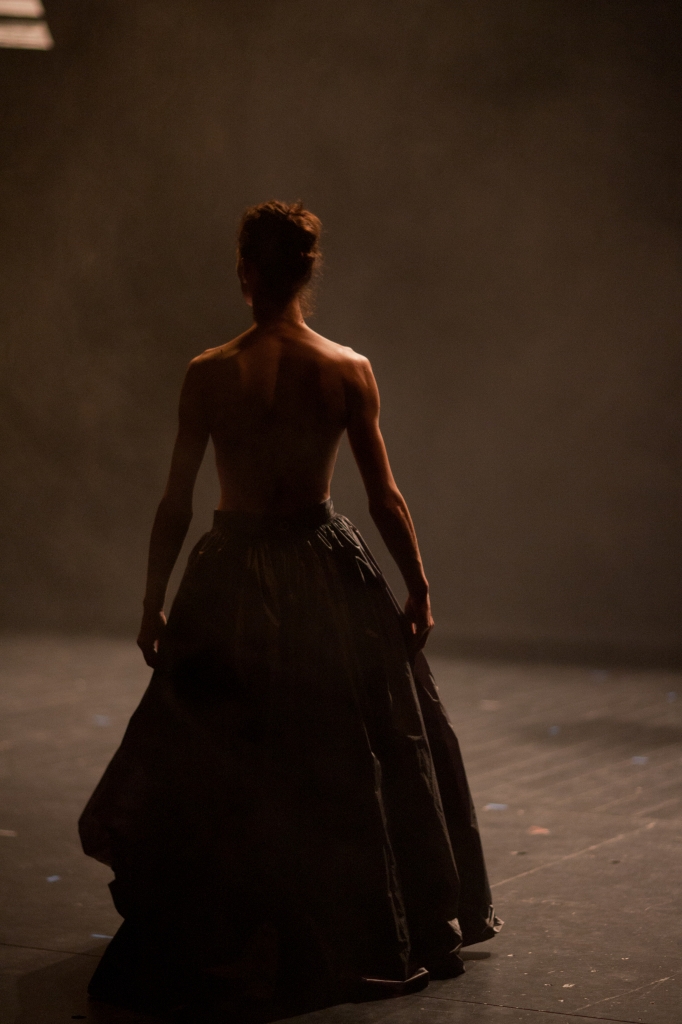
    C’est dans ce dénouement en débordement que se justifie et trouve une cohérence ce qui a précédé, vécu jusque là comme un patchwork déroutant  de danses (vues ou nouvelles), et théâtre, poésie, musique, performance: une étrange carte blanche(1). A commencer par ce long prélude qui sur le coup paraissait fastidieux: trois femmes, dont les robes lugubres et cérémonieuses contrastaient avec les poitrines dénudées, une combinaison comme sacrée. Elles semblaient devoir tournoyer lentement pour l’éternité au son des trois mêmes notes, tandis que trois sorcières de Macbeth lançaient leurs malédictions. C’était, rétrospectivement, un rituel, un envoutement. Aussi une manière de nous faire accepter le principe de répétitions et de subtiles variations comme moyen de faire apparaitre ce qui sinon resterait caché, la mise en œuvre d’une transe au ralenti, diluée. Circulaire également, la lutte ensuite de ces deux guerriers presque nus. Les corps s’attaquaient l’un l’autre en contacts exacerbés, leurs gestes accumulés, saturés, dans un combat d’abord à mort dont la violence s’épuisait peu à peu, en ralentissements, pour se transformer en étreintes amoureuses. Dans cette répétition de mouvements pouvait donc changer la signification de l'ensemble. Par contraste, le corps avait tout à fait disparu de la partie qui suivait: une pure évocation de l’invisible sous trois angles, tentée via trois sensations. La musique de Philippe Glass interprétée au piano, la voix portant la poésie d’Emily Dickinson, les images floues d’un film fantomatique (de Xavier Baërt). Durant cette absence le temps encore s’étirait. On en venait enfin à la dernière histoire, celle de la folie d’un prince- d’un fou-shakespearien(Lionel Hoche), condamné halluciné à répéter encore et encore mots et gestes, enfin à s’en libérer tout en nous entrainant avec lui dans ce cycle. Nous avons été invités à deviner toute cette soirée des recits de fantômes et de disparitions, d’exorcismes enfin.  On peut comprendre ainsi le final, sur une variation d’Amazing Grace. Mais ne sommes- nous pas à notre tour,invités à danser, pris au piège, sommes nous vraiment libérés de ces démons? Je retrouve surtout, au terme de cette soirée rétrospective, ce qui me fascine dans l’art d’Alban Richard: la faculté de faire naitre des émotions brutes de la rigueur et géométrie des formes.

    C’était Shake that Devil d’Alban Richard, au CDC Paris Réseau.

    Guy

    (1) bien que le déroulé de la soirée ai été quelque peu ralenti et dispersé par le parti-pris de la partager entre quatre lieux reliés par des trajets en car: l'Atelier de Paris Carolyn Carlson, le studio Le Regard du Cygne, L'étoile du nord et Micadanses. L'initiative a pour avantage de nous informer que ces structures constituent désormais un centre de développement chorégraphique en réseau (c'est surement une excellente chose), mais aussi pour inconvénient de nous faire mesurer toute la congestion de la circulation routière à Paris et petite couronne...

    photo de Vincent Jeannot avec l'aimable autorisation de la compagnie.

    lire aussi As far as et lointain

    et à lire en anglais...